


We are sharing with you below a beautiful article, written by Richard de Seze for Monde & Vie, dedicated to the future choir stalls of our conventual church.
All the brothers of the community wish you a holy Christmas Eve!
PS. We provide tax-deductible receipts for donations from 🇺🇸🇨🇭🇩🇪🇫🇷
The Choir, Garden of the Virgin
In 2023, the Fraternity of Saint-Vincent-Ferrer consecrated its high altar with the altarpiece sculpted by Remy Insam, in a Tyrolean Gothic style. This year, the columns of the church nave were adorned with alternating gray and white faux-stone bands, in the purest Italian style. And soon the choir will be equipped with Gothic choir stalls and a pulpit, placed at the separation between the nave and the choir: "So that the preaching brother may be considered as a channel through which the Church transmits the teaching of tradition and the doctors to the Church Militant," as Anthony Delarue, the project's architect, explains.
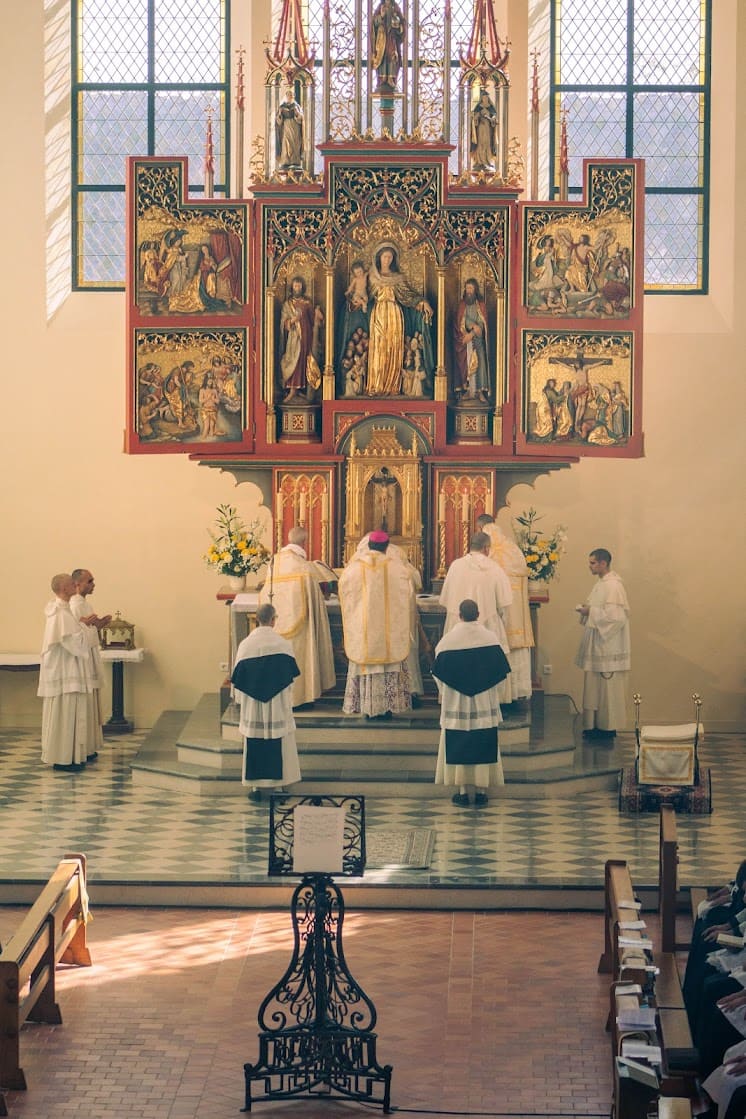
For he has a sense of sacred architecture: "Starting from the Gothic style of the altar, we adapted the level of decoration: the choir is not a place of sacrament, and therefore must be more sober, in keeping with its role. This hierarchy descends from the altar to the nave, and represents, in physical terms, the totality of the Church – triumphant, suffering, and militant." No gilding for the stalls, but patinated oak, darker, more chaste, less glorious.
One might fear a mixture of styles but no, precisely: the variety of styles is the very symbol of the passage of time, of continuity; the variety of influences, that of the universality of the Church, truly inclusive. But this Gothic, still, isn't this pastiche? "Not at all! This work is part of a long tradition of solid oak woodworking, an unbroken tradition. At the stylistic level, the details and forms, even within a Gothic tradition, remain simple and of our time, the 21st century with roots passing through the liturgical movement of the 20th, when I learned my craft. No one could confuse them with antique stalls!" Anthony Delarue speaks as an expert since he has been restoring numerous antique stalls for more than thirty years, and sometimes designs new ensembles, like the one at Wigratzbad.
It was there that he met Father Augustin-Marie Aubry, the prior of the Fraternity of Saint-Vincent-Ferrer, in 2023. Invited to stay at Chémeré-le-Roi, he conceived in a few months a project of more than thirty stalls. The project, validated in chapter in 2024 ("The Fraternity of Saint-Vincent-Ferrer is composed of men who know what they want and who ask for nothing before having reflected on it at length!" the architect points out), was launched more than a year ago: calls for bids from companies accustomed to working on heritage sites, visits to six woodworking shops, choice in 2025 of the Aubert-Labansat workshops, located in Coutances, a "historic monument restoration company," which participated in the great construction site of Notre-Dame de Paris by reconstructing the spire's staircase.
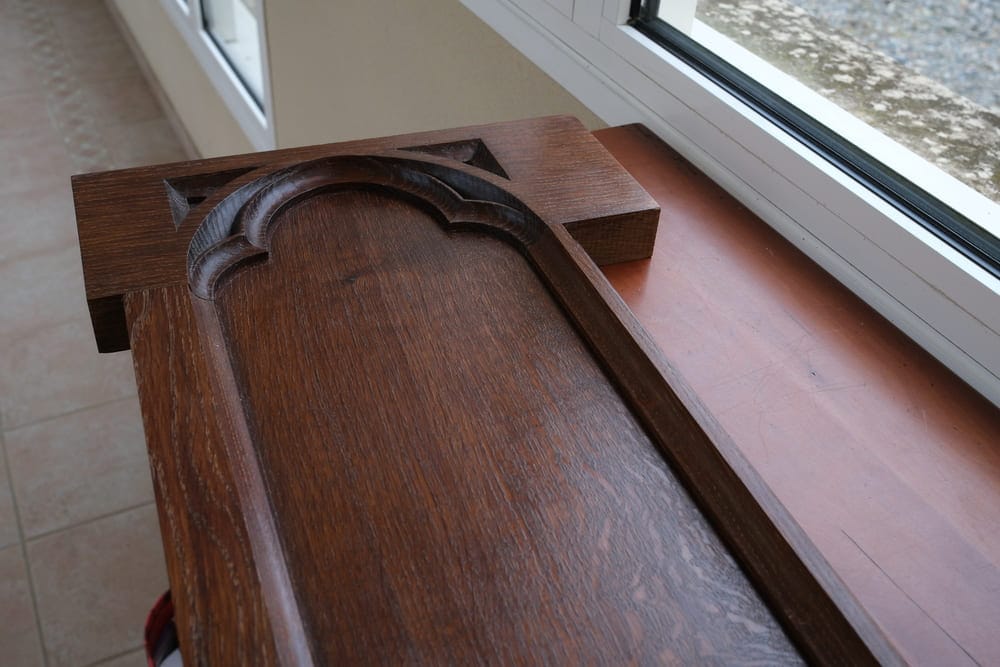
It is in Coutances that each piece – in oak from Sarthe, cut in Mayenne: a local project! – will be carved and assembled at the ideal moment ("the wood is at 14% humidity, we wait until it's at 11%" explains the workshop manager); that each sculpture is made, after agreeing the clay models, for the most delicate ones, like the large vegetal motifs, flowers and fruits, which will decorate the stall ends. "The choir is the garden of the Virgin and its decoration 'translates' the text of the offertory of the Mass of the Rosary," specifies Father Aubry.
Obaudíte me, divíni fructus, et quasi rosa plantáta super rivos aquárum fructificáte : quasi Líbanus odórem suavitátis habéte ("Listen to me, my devout children, and grow like the rose by a watercourse. Like Lebanon, spread a sweet fragrance").
The stalls will be installed in July 2026, after a "white assembly" in the spring: to ensure to the millimetre that everything is in place: invisible, but paramount, the quality of materials and excellence of craftsmanship, which go back to the Middle Ages, guarantee that the stalls will last for centuries. Ancient forests, medieval traditions and age-old liturgies will combine so that the teaching of tradition unfolds today.
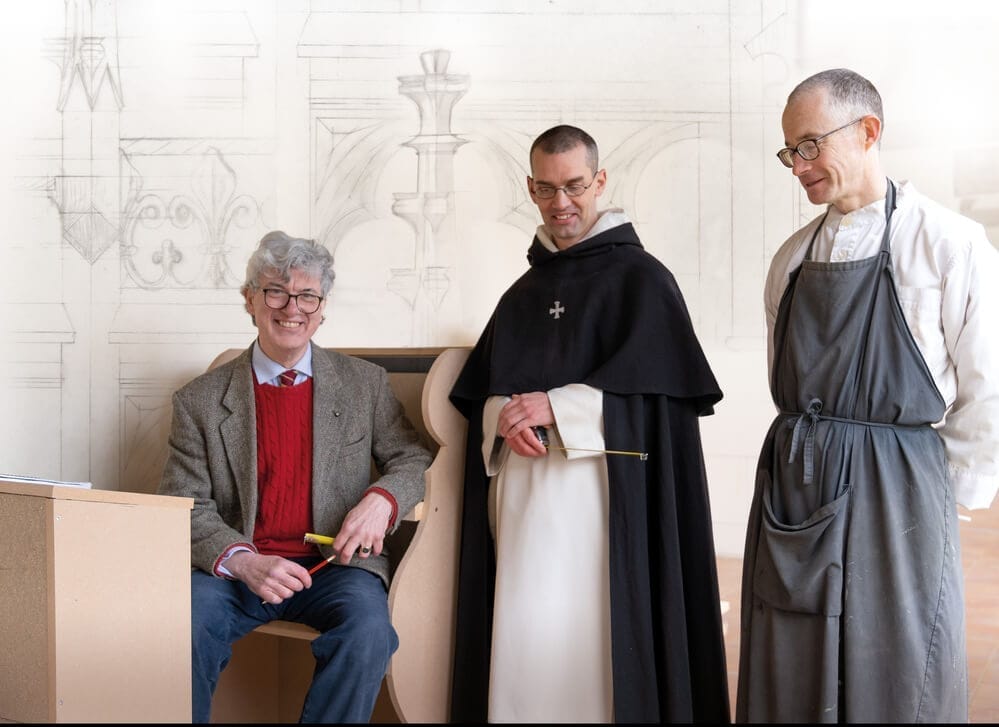
Inscribing Oneself in Tradition
Anthony Delarue is a member of the Traditional Architecture Group of the Royal Institute of British Architects. "I was fortunate, raised in England, to attend school near a great medieval church, and every morning we were in the stalls for assembly, so the spirit of the choir is part of my formation. I am very grateful to Providence for this." In an interview with the Oscottian Magazine, Delarue explained: "The only thing I have never learned is modernism, whatever that may be." He worked on the restoration of the English seminary St Mary's College, at Oscott, near Birmingham: "the chapel, designed by the famous 19th-century Anglo-French architect, Augustus Pugin, contains 16th-century Flemish stalls. These have a row of pinnacles, against the wall, which I adopted at Chémeré. It serves to soften a hard horizontal line." Let us summarize: tradition offers solutions.
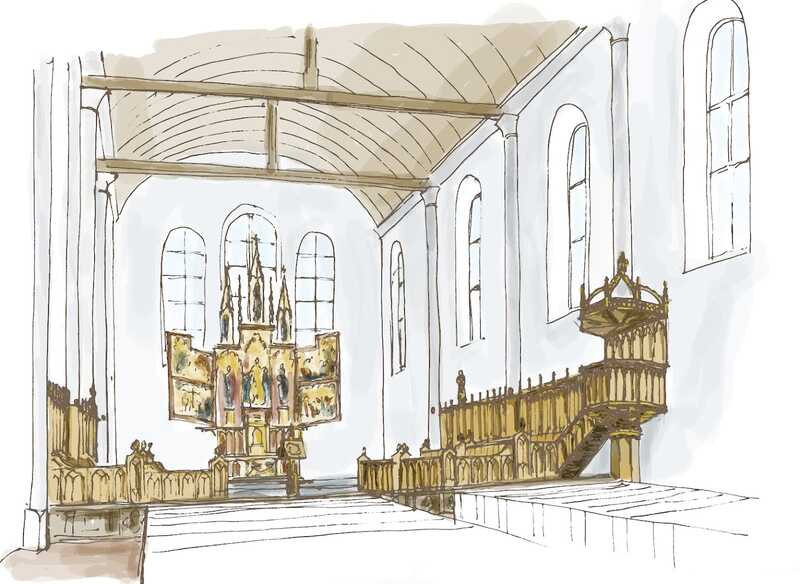
Help us with the construction of the stalls and pulpit, for the praise of God and preaching!
Your donation will help a community of preachers grow, by providing stalls to welcome the brothers and future vocations:
- oak from Sarthe (France), cut in Mayenne
- work entrusted to the Aubert-Labansat workshops, in Manche
- fabrication begun in October 2025
We provide tax-deductible receipts for donations from 🇺🇸🇨🇭🇩🇪🇫🇷